Flat Belts-Packaged Goods Transfer/Electronic Parts Transfer
Caution
Product Description
Flat Belts-Packaged Goods Transfer/Electronic Parts Transfer
This conveyor belt is not only ideal for use in mini belt conveyor systems but also boasts electronic industry. It is available in a wide range of sizes to suit your needs.
[Feature]
● Belt Width Minimum / Maximum (mm.) : 10 mm. and 500 mm.
● Thickness (mm.): 0.8, 0.9, 1.4, 1.8, and 2
● Belt Length (m.) : The size is configurable between 0.5 to 20 m, and the minimum length can be increased by increments 0.01 m.
● Suitable for Minimum Pulley Belt Diameter Size (mm.) : 15, 25 and 30
● Surface Cover Material: Conductive Polyurethane, Suede Non-Woven Fabric
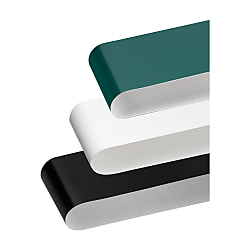
● Color: White, Green and Black
[Application]
It is used in conjunction with pulleys to transfer materials in a conveyor system.
Flat belts for packaged-goods and electronic-parts transfer
Flat-surface belts for transferring packaged goods or electronic parts with pulleys. The belt circumference L is measured along the back surface as the inner circumference. A greater ply count permits higher allowable tension but needs a larger minimum pulley diameter, so check both. A pulley below the minimum diameter may cause slipping.
- W is configurable from 10 mm to 500 mm for the stated standard range (DHBLT also W 5).
- L is configurable in 0.01 m increments within the range assigned to the selected width and Type.
- FBLG, FBLW, FBLGN and FBLWN require a circumference of 0.70 m or more.
Types and components
Belt circumference is the length of the belt underside (inner circumference).
Flat belt tolerances
| Width tolerance | Thickness tolerance | Length tolerance | ||||
| Width | Tolerance | Thickness | Tolerance | Joint tolerance | Length | Tolerance |
|---|---|---|---|---|---|---|
| –400 | ±2 | –1.0 | ±0.1 | ±0.3 | –2000 | ±10 |
| 401–500 | ±3 | 1.1–1.5 | ±0.2 | 2001–7000 | ±20 | |
| 1.6–2.0 | 7001–10000 | ±0.3% | ||||
| 2.1–5.5 | ±0.4 | 10001– | ||||
Permanent belt elongation is max. 1% of the total length (reference).
| Type | Color | Ply Quantity | Surface shape | Material | Friction coefficient (reference value vs. polished steel) | Thickness mm | Unit mass kg/m² | Allowable tension N/mm (length direction) | Min. pulley dia. φmm | Knife Edge | Continuous use Temperature °C | ||
|---|---|---|---|---|---|---|---|---|---|---|---|---|---|
| Surface | Back | Front | Back | ||||||||||
| FBLW | White | 1 | Flat | Suede-like nonwoven fabric | Polyester canvas | - | - | 1.8 | 1.2 | 4 | 25 | × | -5–60 |
| FBLGN | Green | 2 | Flat | Suede-like nonwoven fabric | Polyester canvas | - | - | 2 | 1.5 | 5 | 30 | × | -5–60 |
| DHBLT | Black | 1 | Flat | Conductive polyurethane | Polyester | 0.3 | 0.15 | 0.9 | 1 | 3.5 | 30 | R10 | -10–80 |
| DHBLTS | Black | 1 | Flat | Conductive polyurethane | Polyester | 0.8 | 0.2 | 0.8 | 0.7 | 4 | 15 | R3 | -10–80 |
| DHBLGN | Black | 2 | Flat | Thermoplastic polyurethane | Polyester canvas | 0.6 | 0.2 | 1.4 | 1.5 | 8 | 25(15)*1 | (R3)*1 | -30–80 |
- *1: Values in ( ) are for an allowable tension of 5 N/mm.
Ply number is the number of fabric layers in the belt. More layers give a higher allowable tension but a larger minimum pulley diameter.
| Type | Food hygiene | Antibacterial, antifungal | Prevents fraying | Water and humid heat resistance | Prevents heat shrinkage | Surface cleanability | Prevents rub-in shrinkage | Sodium hypochlorite resistance | Non-stick | Oil resistance |
|---|---|---|---|---|---|---|---|---|---|---|
| FBLW | △ | - | - | - | - | - | ○ | - | ○ | - |
| FBLGN | △ | - | - | - | - | - | ○ | - | ○ | - |
| DHBLT | ○ | - | - | △ | △ | △ | △ | △ | △ | △ |
| DHBLTS | - | - | ○ | - | - | - | - | - | - | ○ |
| DHBLGN | - | - | ○ | - | - | - | - | - | - | ○ |
◎: excellent, ◯: suitable, △: may be attacked, -: not suitable
Previous standard (until 2014)
| Type | Friction coefficient (reference value vs. polished steel) | Thickness mm | Unit mass kg/m² | Allowable tension N/mm | Min. pulley dia. φmm | Knife edge | Continuous use temperature °C | |
|---|---|---|---|---|---|---|---|---|
| Front | Back | |||||||
| DHBLT | 0.2 | 0.1 | 0.6 | 0.7 | 3 | 25 | R3 | -10–80 |
Part numbers and dimensions
Ordering example
| Type | - | Circumference L (m) | |
|---|---|---|---|
| Type | Belt width | ||
| DHBLT | 50 | - | 4.23 |
| Type | Circumference L (m) | |
|---|---|---|
| Type | Belt width W(mm) | Specified 0.01 m increments |
| DHBLT | 5 | 0.50– 3.00 |
| FBLW*2 FBLGN*2 DHBLT DHBLTS DHBLGN | 10 | 0.50–20.00 |
| 15 | ||
| 20 | ||
| 25 | 0.80–20.00 | |
| 30 | ||
| 35 | ||
| 40 | ||
| 50 | ||
| 60 | ||
| 70 | ||
| 75 | ||
| 80 | ||
| 90 | ||
| 100 | ||
| 110 | ||
| 120 | ||
| 125 | ||
| 130 | ||
| 140 | ||
| 150 | ||
| 160 | ||
| 170 | ||
| 180 | ||
| 190 | ||
| 200 | ||
| 210 | ||
| 220 | ||
| 230 | ||
| 240 | ||
| 250 | ||
| 260 | ||
| 270 | ||
| 280 | ||
| 290 | ||
| 300 | ||
| 310 | ||
| 320 | ||
| 330 | ||
| 340 | ||
| 350 | ||
| 360 | ||
| 370 | ||
| 380 | ||
| 390 | ||
| 400 | ||
| 410 | ||
| 420 | ||
| 430 | ||
| 440 | ||
| 450 | ||
| 460 | ||
| 470 | ||
| 480 | ||
| 490 | ||
| 500 | ||
- The DHBLT joint may be about 0.3 mm thicker. *2: FBLW and FBLGN are specified from circumference 0.70.
- For calculating the length of flat belts used on MISUMI conveyors, see below.
- *Formulas differ by conveyor. Always check the "Belt length formula" on the product page you use.
Formula example (GVHA): (2L+98)/1000, length unit: m
- *Rounded to 2 decimal places. L is the distance between conveyor pulleys. Example GVHA-30-500-25-T100-IM-5-D-AS: L = 500, (1000+98)/1000 = 1.1 (1.098 rounded)
Belt part number example: DHBLT30-1.1
Technical information
- Below the minimum pulley diameter, the belt may slip on the pulley.
Belt life is hard to calculate; replace the belt when damage or surface wear is seen.
- Run the belt in the direction of the arrow printed on the body.