Stainless Steel Belts
Caution
Product Description
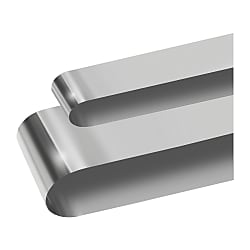
Stainless Steel Belts
This conveyor belt is superior flatness, heat resistance, and electrical conductivity. Moreover, it is come up with a wide range of sizes available to choose from.
[Feature]
● Belt Width Minimum / Maximum (mm.) : 10 mm. and 150 mm.
● Thickness (mm.): 0.1, 0.15 and 0.2
● Belt Length (m.) : The size is configurable between 1 to 10 m., and the minimum length can be increased by increments 0.01 m.
● Suitable for Minimum Pulley Belt Diameter Size (mm.) : 50, 75 and 100
● Material: SUS304H
[Application]
It is used in conjunction with pulleys to transfer materials in a conveyor system.
Stainless Steel Belts: STHBLT
Stainless steel belt with excellent flatness, heat resistance and electrical conductivity. Material: SUS304H. Surface: flat. Belt width: 10–150 mm. Belt circumference: 0.5–10 m.
Part number: Type – Belt thickness – Belt width (mm) – Circumference L (m) (example: STHBLT0.15-25-2.24).
- Belts are shipped endless-welded.
- Belt circumference is the length of the back side of the belt (inner circumference).
- There is no specified running direction for the belt.
- Belt thickness tolerance is ±10% of the belt thickness.
Related products: Pulleys for Stainless Steel Belts (crowned type); Idlers for Stainless Steel Belts (crowned type).
STHBLT specifications by thickness
| Type | Material | Thickness (mm) | Weight (kg/m²) | Allowable tension (kg/cm) | Min. pulley Ø (mm) | Continuous operating temp. (°C) | Surface electrical resistance (Ω) | Friction coefficient (reference, vs. polished steel) | Surface hardness (HV) | Young’s modulus (kgf/mm2) | Thermal expansion coefficient (×10−6/°C) |
|---|---|---|---|---|---|---|---|---|---|---|---|
| STHBLT | SUS304H | 0.1 | 0.8 | 4 | 50 | −80 to 110 | 0.2 | 0.2 | 370 or more | 19700 | 17.3 |
| 0.15 | 1.2 | 6 | 75 | −80 to 120 | 0.3 | ||||||
| 0.2 | 1.6 | 8 | 100 | −80 to 130 | 0.5 |
STHBLT width and circumference ordering limits
| Type | Belt thickness T (mm) | Belt width W (mm), 1 mm increments | Circumference L (m), 0.01 m increments |
|---|---|---|---|
| STHBLT | 0.1 / 0.15 / 0.2 | 10–20 | 0.50–10.00 |
| 21–30 | 0.80–10.00 | ||
| 31–40 | |||
| 41–50 | |||
| 51–60 | |||
| 61–70 | |||
| 71–80 | |||
| 81–90 | |||
| 91–100 | |||
| 101–120 | |||
| 121–140 | |||
| 141–150 |
Widths 10–20 mm start at a minimum circumference of 0.50 m; widths 21 mm and above start at 0.80 m. Exceptions (0.1 mm thickness): widths 40, 50 and 60 mm start at 0.66 m, and widths 70 and 80 mm start at 0.77 m (e.g. STHBLT0.1-70-[0.77-10/0.01]). For 0.15 mm and 0.2 mm belts these widths start at 0.80 m. Select the width before assuming the minimum circumference.
Dimensional tolerances and installation limits
| Width (W) | ±0.1 mm |
|---|---|
| Thickness (T) | ±10% of belt thickness |
| Circumference | ±1 mm/m |
- Use the dedicated crowned pulleys and idlers for stainless steel belts.
- Do not apply tension from the back surface of the belt.
- Operation below the minimum pulley diameter may cause slipping between the belt and pulley.
Conveyor uses and thickness restrictions
Application examples: image inspection; sterilization with UV or alcohol; accumulation conveying; LCD and solar-panel conveying.
- Thicknesses 0.1 mm and 0.15 mm are not suitable for accumulation conveying.
- Avoid impact through the thickness because the belt is very thin.
- Slide workpieces onto the belt with a chute or equivalent arrangement to avoid impact.
- Because the belt is thin, conveying heavy or hard workpieces (such as metal parts) can easily scratch the belt and may cause it to break.
Contact surfaces, debris, and replacement checks
- Do not continue operation with debris trapped between the belt, belt support plate, or work guide.
- Use contacting parts with a surface hardness lower than that of the belt.
- Dents can shorten belt life, so prevent impacts and inspect the belt surface for damage.
- Use visible belt damage or surface wear as the replacement criterion because belt life is difficult to calculate.
Food and chemical resistance
○ = resistant, △ = limited resistance, × = not resistant. Confirm the process fluid before use.
Food resistance
| Food | Stainless steel belt |
|---|---|
| STHBLT | |
| Yeast | ○ |
| Tea leaves | ○ |
| Olive oil | ○ |
| Fruit | ○ |
| Cashew nuts | ○ |
| Cream | ○ |
| Spices | ○ |
| Grains | ○ |
| Coffee beans | ○ |
| Wheat flour | ○ |
| Rice | ○ |
| Fish | ○ |
| Sugar | ○ |
| Table salt | ○ |
| Salt water | ○ |
| Fat | ○ |
| Edible oil | ○ |
| Syrup | ○ |
| Soy sauce | ○ |
| Vinegar | ○ |
| Sauce | ○ |
| Molasses | ○ |
| Meat | ○ |
| Butter | ○ |
| Bread | ○ |
| Peanut oil | ○ |
| Beer | ○ |
| Margarine | ○ |
| Mayonnaise | ○ |
| Water | ○ |
| Lard | ○ |
Chemical resistance
| Chemical | Stainless steel belt |
|---|---|
| STHBLT | |
| Isopropyl alcohol | ○ |
| Ethanol | ○ |
| Potassium chloride | ○ |
| Calcium chloride | ○ |
| Hydrochloric acid (gas) | × |
| Hydrochloric acid (5% or less) | × |
| Hydrochloric acid (5–36%) | × |
| Caustic soda | ○ |
| Caustic soda solution (50%) | ○ |
| Gasoline (volatile oil) | ○ |
| Strong alkali | ○ |
| Strong acid | × |
| Light oil | ○ |
| Ethyl acetate | △ |
| Sodium hypochlorite (undiluted) | × |
| Sodium hypochlorite (600 ppm) | × |
| Weak alkali | ○ |
| Weak acid | ○ |
| Soap | ○ |
| Cutting oil | ○ |
| Diesel oil | ○ |
| Toluene | ○ |
| Naphthalene | ○ |
| Paraffin oil | ○ |
| Phenol | ○ |
| Rust-preventive oil | ○ |
| Machine oil | ○ |
| Methanol | ○ |
| Sulfuric acid (10%) | × |
| Sulfuric acid (50%) | × |
| Sulfuric acid (70%) | × |
| Sulfuric acid (98%) | × |