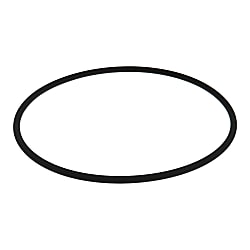
O-Ring G Series
Brand :
MISUMI
Caution
Product Description
This is an economy item, The price is cheaper than the MISUMI standard product.
Product Overview
O-rings are sealing components that utilize the elastic interference of rubber materials. The economical O-ring G Series is manufactured according to the JIS B 2401 G Series standard.
The usage method is fixed type, and after installation, the O-ring remains in a fixed position.
The usage method is fixed type, and after installation, the O-ring remains in a fixed position.
Dimensional Drawing

Specifications Overview
The economical G Series O-rings are available in two materials: Nitrile Rubber and Fluororubber.
| Type |  Material Material |  Hardness (JIS Hs) Hardness (JIS Hs) | Color | Usable Temperature Range | Intended Use | |
| E-PACK-NGA | Nitrile Rubber | HS65 | +10 0 | Black | -20 to 100°C | For mineral oil resistance |
| E-PACK-NGF | Fluororubber | Black | -10 to 200°C | For High Temperature | ||
Specification Table
| Part Number | JIS Nominal Number | W | Internal Diameter | Related Materials | ||||||
| Type | No. | do | NGA Tolerance | NGF Tolerance | d | Tolerance | D | Tolerance | ||
| JIS B 2401 G Series E-PACK-NGA (Nitrile Rubber·Black) E-PACK-NGF (Fluororubber·Black) | 25 | G25 | 3.1±0.1 | 24.4 | ±0.25 | ±0.30 | 25 | 0 -0.10 | 30 | +0.10 0 |
| 30 | G30 | 29.4 | ±0.29 | ±0.35 | 30 | 35 | ||||
| 35 | G35 | 34.4 | ±0.33 | ±0.40 | 35 | 40 | ||||
| 40 | G40 | 39.4 | ±0.37 | ±0.45 | 40 | 45 | ||||
| 45 | G45 | 44.4 | ±0.41 | ±0.50 | 45 | 50 | ||||
| 50 | G50 | 49.4 | ±0.45 | ±0.54 | 50 | 55 | ||||
| 55 | G55 | 54.4 | ±0.49 | ±0.59 | 55 | 60 | ||||
| 60 | G60 | 59.4 | ±0.53 | ±0.64 | 60 | 65 | ||||
| 65 | G65 | 64.4 | ±0.57 | ±0.69 | 65 | 70 | ||||
| 70 | G70 | 69.4 | ±0.61 | ±0.74 | 70 | 75 | ||||
| 75 | G75 | 74.4 | ±0.65 | ±0.78 | 75 | 80 | ||||
| 80 | G80 | 79.4 | ±0.69 | ±0.83 | 80 | 85 | ||||
| 105 | G105 | 104.4 | ±0.87 | ±0.87 | 105 | 110 | ||||
| 120 | G120 | 119.4 | ±0.98 | ±0.98 | 120 | 125 | ||||
| 145 | G145 | 144.4 | ±1.16 | ±1.16 | 145 | 150 | ||||
| 170 | G170 | 5.7±0.1 | 169.3 | ±1.33 | ±1.33 | 170 | 180 | |||
Usage Method
| Type | No. | G Dimension(Tolerance+0.25/0) | H Dimension H±0.05 | R Dimension Max. Value | ||
| No Back-Up Ring | Back-Up Ring on One Side | Back-Up Rings on Both Sides | ||||
| E-PACK-NGA E-PACK-NGF | 25~145 | 4.1 | 5.6 | 7.3 | 2.4 | 0.7 |
| 170 | 7.5 | 9 | 11.5 | 4.6 | 0.9 | |


Product Feature
1. Simple structure and easy installation.
2. Wide variety of materials and sizes.
2. Wide variety of materials and sizes.
Precautions
After synthetic rubber comes into contact with different liquids, the following phenomena may occur depending on the type of liquid.
● Expands (swells) after absorbing liquid
● Bonding breaks down (decomposes) after chemical reaction
● Product becomes finer after additives precipitate (extraction)
The above adverse reactions for rubber often cause poor sealing performance in sealing products. It is recommended to confirm whether the material will react with the sealing medium before selecting sealing product materials.
In addition, temperature and the type of additives can also affect the reaction results; even reactions with the same medium can differ at different temperatures. When liquids are mixed, their combined effect multiplies, significantly increasing the impact on rubber.
● Expands (swells) after absorbing liquid
● Bonding breaks down (decomposes) after chemical reaction
● Product becomes finer after additives precipitate (extraction)
The above adverse reactions for rubber often cause poor sealing performance in sealing products. It is recommended to confirm whether the material will react with the sealing medium before selecting sealing product materials.
In addition, temperature and the type of additives can also affect the reaction results; even reactions with the same medium can differ at different temperatures. When liquids are mixed, their combined effect multiplies, significantly increasing the impact on rubber.