Flat Belt Food Grade

Brand :
MISUMI
Caution
Product Description
Product Overview
Flat belts are belts with a rectangular cross-section.
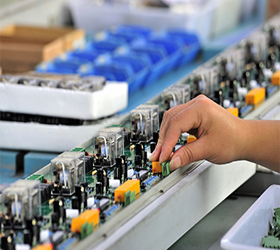
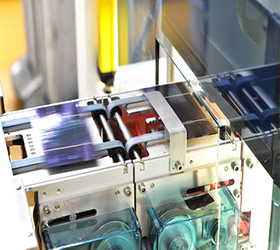
Depending on material properties, number of layers, color, and surface shape, they can convey a variety of workpieces such as food, electronic components, and corrugated cardboard, and are widely used across various fields and industries.
Depending on material properties, number of layers, color, and surface shape, they can convey a variety of workpieces such as food, electronic components, and corrugated cardboard, and are widely used across various fields and industries.
Dimensional Drawing

Material Table
Type
| Series | Type |  Material Material | Color | Surface Shape | Number of Layers | Thickness mm | Minimum Pulley Diameter ⌀mm | Allowable Tension N/mm | Unit Weight kg/m² | Coefficient of friction (reference value against ground steel) | Knife Edge | Continuous Operating Temperature ℃ | ||
| Surface | Back | Surface | Back | |||||||||||
| Food grade | E-KHBLTUW1.0 | Thermoplastic polyurethane | Polyester fabric | White | Flat Surface | 1 | 1 | 15 | 4 | 1.2 | 0.3 to 0.4 | 0.1 | R4 | -15 to 80 |
| E-KHBLTUW1.2 | Thermoplastic polyurethane | Polyester fabric | White | Flat Surface | 1 | 1.2 | 30 | 4 | 1.2 | 0.3 to 0.4 | 0.1 | R4 | -15 to 80 | |
| E-KHBLTUW1.4 | Thermoplastic polyurethane | Polyester fabric | White | Flat Surface | 2 | 1.4 | 40 | 6 | 1.7 | 0.3 to 0.4 | 0.1 | R4 | -15 to 80 | |
| E-KHBLTUW1.5 | Thermoplastic polyurethane | Polyester fabric | White | Flat Surface | 2 | 1.5 | 40 | 6 | 1.7 | 0.3 to 0.4 | 0.1 | R4 | -15 to 80 | |
| E-KHBLTUW2.0 | Thermoplastic polyurethane | Polyester fabric | White | Flat Surface | 2 | 2 | 60 | 6 | 2.3 | 0.3 to 0.4 | 0.1 | - | -15 to 80 | |
| E-KHBLTUB0.8 | Thermoplastic polyurethane | Polyester fabric | Blue | Flat Surface | 1 | 0.8 | 15 | 4 | 0.9 | 0.3 to 0.4 | 0.1 | R4 | -15 to 80 | |
| E-KHBLTUB1.2 | Thermoplastic polyurethane | Polyester fabric | Blue | Flat Surface | 1 | 1.2 | 20 | 4 | 1.2 | 0.3 to 0.4 | 0.1 | R4 | -15 to 80 | |
| E-KHBLTUB2.0 | Thermoplastic polyurethane | Polyester fabric | Blue | Flat Surface | 2 | 2 | 50 | 4 | 2.3 | 0.3 to 0.4 | 0.1 | R4 | -15 to 80 | |
| Food grade Anti-fraying | E-KMHBLTUW1.4 | Thermoplastic polyurethane | Polyester fabric | White | Flat Surface | 2 | 1.4 | 20 | 6 | 1.7 | 0.3 to 0.4 | 0.1 | - | -15 to 80 |
| E-KMHBLTUW2.0 | Thermoplastic polyurethane | Polyester fabric | White | Flat Surface | 2 | 2 | 50 | 6 | 2.3 | 0.3 to 0.4 | 0.1 | - | -15 to 80 | |
| E-KMHBLTUB1.5 | Thermoplastic polyurethane | Polyester fabric | Blue | Flat Surface | 2 | 1.5 | 20 | 6 | 1.7 | 0.3 to 0.4 | 0.1 | - | -15 to 80 | |
 If the above products do not meet your requirements, custom inquiries for flat belt products are accepted.
■ Width Tolerance
| Width (mm) | Tolerance |
| ~100 | 0 ~ -2 |
| 101~400 | 0 ~ -2 |
| 401~500 | 0 ~ -3 |
■ Thickness Tolerance
| Thickness (mm) | Tolerance | Fitting Part Tolerance |
| ~1.0 | ±0.1 | ±0.3 |
| 1.1~1.5 | ±0.2 |
■ Length Tolerance
| Length (mm) | Tolerance |
| ~2000 | ±10 |
| 2001~7000 | ±20 |
| 7001~10000 | ±0.3% |
| 10001~ | ±0.3% |
The belt joint has already been processed before shipment.The permanent elongation rate of the belt is up to 1% of the total length (reference value).The inner circumference is regarded as the circumference.Please check the width tolerance of the pulley and idler before selecting the belt model.Specification Table
 Type Type |  Belt Width Belt WidthW (mm) Specified unit: 5 mm |  Circumference CircumferenceL (m) Specified unit: 0.01 m | Thickness (mm) |
| E-KHBLTUW1.0 | 10–500 | 0.70–20.00 | 1 |
| E-KHBLTUW1.2 | 1.2 | ||
| E-KHBLTUW1.4 | 1.4 | ||
| E-KHBLTUW1.5 | 1.5 | ||
| E-KHBLTUW2.0 | 2 | ||
| E-KHBLTUB0.8 | 0.8 | ||
| E-KHBLTUB1.2 | 1.2 | ||
| E-KHBLTUB2.0 | 2 | ||
| E-KMHBLTUW1.4 | 1.4 | ||
| E-KMHBLTUW2.0 | 2 | ||
| E-KMHBLTUB1.5 | 1.5 |
Product Features
Feature 1: Complete specifications, widely used, available in a variety of colors and surface shapes
For general use: suitable for general conveying purposes of food packaging, cardboard boxes, metal, and plastic, etc.→ New specifications for this type will be launched in 2026
For electronic parts: anti-static specifications, suitable for the transmission of anti-static electronic parts. The surface resistivity value is 10⁶~10⁸Ω.→ New specifications for this type will be launched in 2026
For sliding: canvas with sliding performance in longitudinal direction is used to make the conveying objects stay and be arranged above the Conveyor Belt.→ New specifications for this type will be launched in 2026
For conveying bulk materials: The surface is of textured shape, which can be used in horizontal transportation of bulk objects.
 Food grade: Products that can come into direct contact with meat, pastries, noodles, and other foods, featuring non-toxic, antibacterial, and mold-resistant properties.
For inclined conveying: By selecting different surface textures, items can be retained or arranged during inclined conveying applications.
*For a comparison of relevant product models and actual items, please refer to the comparison table! (New product photos are being taken—please stay tuned. Images are for reference only; actual products may differ in color. Please refer to the actual product!)
Feature 2: Professionally tested by a third party, meets relevant standards, and ensures quality for your use
Food grade:
① Complies with the GB 4806.11-2023 National Food Safety Standard for rubber materials and products intended for food contact.
*These test results are for individual products tested under the following conditions. If there are other components or equipment present on site, we cannot guarantee that the test results will be the same.
Migration conditions: 95% ethanol, 40℃
*Under this standard, it is recommended for use in applications involving contact with dry or wet products. It is not recommended for use with oily products. If contact with oily products is required, please test to ensure it meets your usage requirements!
② Based on the method specified in the GB 31604.30-2016 National Food Safety Standard for the determination and migration of phthalates in food contact materials and articles, tests were conducted for phthalate substances (a widely used plasticizer), and none were detected, meeting the national food safety standards.
Antistatic:
Complies with the ANSESD S20.20-2021 ESD control system standard for electrostatic protection, with a surface resistivity of 106 to 109 Ω.
*These test results are for individual products under the following conditions. Due to the influence of the environment, surrounding equipment, etc., our company does not guarantee the same test results. For reference only.
Test method: GB/T 31838.3-2019
Test conditions: temperature 23±2℃, humidity 50±5%
Feature 3: Prevents the common issue of "workpiece displacement" during the transport of lightweight workpieces
· The back side of the MISUMI economy flat belt uses a fabric with higher rigidity, which effectively improves belt edge curling and can prevent workpiece displacement when transporting lightweight items.For general use: suitable for general conveying purposes of food packaging, cardboard boxes, metal, and plastic, etc.→ New specifications for this type will be launched in 2026
For electronic parts: anti-static specifications, suitable for the transmission of anti-static electronic parts. The surface resistivity value is 10⁶~10⁸Ω.→ New specifications for this type will be launched in 2026
For sliding: canvas with sliding performance in longitudinal direction is used to make the conveying objects stay and be arranged above the Conveyor Belt.→ New specifications for this type will be launched in 2026
For conveying bulk materials: The surface is of textured shape, which can be used in horizontal transportation of bulk objects.
 Food grade: Products that can come into direct contact with meat, pastries, noodles, and other foods, featuring non-toxic, antibacterial, and mold-resistant properties. For inclined conveying: By selecting different surface textures, items can be retained or arranged during inclined conveying applications.
*For a comparison of relevant product models and actual items, please refer to the comparison table! (New product photos are being taken—please stay tuned. Images are for reference only; actual products may differ in color. Please refer to the actual product!)
Feature 2: Professionally tested by a third party, meets relevant standards, and ensures quality for your use
Food grade:
① Complies with the GB 4806.11-2023 National Food Safety Standard for rubber materials and products intended for food contact.
*These test results are for individual products tested under the following conditions. If there are other components or equipment present on site, we cannot guarantee that the test results will be the same.
Migration conditions: 95% ethanol, 40℃
*Under this standard, it is recommended for use in applications involving contact with dry or wet products. It is not recommended for use with oily products. If contact with oily products is required, please test to ensure it meets your usage requirements!
② Based on the method specified in the GB 31604.30-2016 National Food Safety Standard for the determination and migration of phthalates in food contact materials and articles, tests were conducted for phthalate substances (a widely used plasticizer), and none were detected, meeting the national food safety standards.
Antistatic:
Complies with the ANSESD S20.20-2021 ESD control system standard for electrostatic protection, with a surface resistivity of 106 to 109 Ω.
*These test results are for individual products under the following conditions. Due to the influence of the environment, surrounding equipment, etc., our company does not guarantee the same test results. For reference only.
Test method: GB/T 31838.3-2019
Test conditions: temperature 23±2℃, humidity 50±5%
Feature 3: Prevents the common issue of "workpiece displacement" during the transport of lightweight workpieces

*Market-available products refer to similar items randomly purchased by our company from online or offline markets.
Feature 4: Quality assurance at the joint section for smooth conveying
· The seam of the MISUMI economy flat belt is smooth and flat, which can prevent conveying failures caused by belt jumping or uneven seams.

*Market-available products refer to similar items randomly purchased by our company from online or offline markets.
Feature 5: Usage distinction between Misumi Economy Series and Misumi Standard Series
· The difference between the Misumi Economy Series and the Misumi Standard Series is in noise performance
· Noise performance is not significantly affected during actual use due to the ambient noise from surrounding equipment

*The difference in friction noise when rubbing against iron plates supporting the conveyor belt is about 5 decibels. The reference value for friction noise is based on the results of actual tests with MISUMI conveyors and is for reference only.
Usage Method
■ Flat belt tension adjustment
The suitable tension force of the flat belt depends on the structure of the Conveyor Belt, material, the weight of the goods, etc., so it can not be determined as a few percent.
Please do not over-tension as it is permanently tensioned. Please refer to the following method for adjusting method.
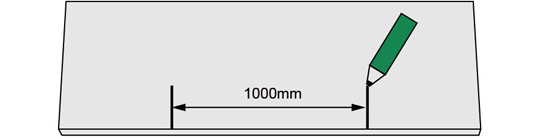
①Select a length of 1000mm and draw a mark on an inconspicuous part of the flat belt or Conveyor Belt.
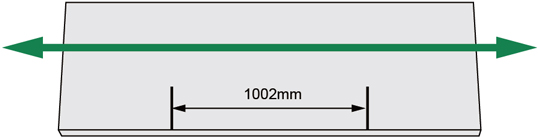
② Slowly tension the flat belt until the marking line reaches 1002mm.
③ Drive the flat belt or Conveyor Belt in this state and confirm that the flat belt is not slipping. (If the flat belt deflects, then adjust it)
Carry out the transmission test after confirming no problems. If the transmission is smooth, you can continue to use the belt.
If the flat belt slips after the item is put on, perform Step ④.
④ When the flat belt slips, please tighten the flat belt slightly. Every time you need to confirm the slip until the flat belt does not slip.
Adjust the deviation and carry out the transmission test. Confirm smooth transmission before use.
⑤ It is recommended to check the tension state regularly.
■ Simple selection steps for flat belt
① Determine the necessary conditions for selection. (Maximum total weight of workpiece, pulley diameter, transmission power, etc.)
② Calculate the stress borne by the belt.
③ Choose the belt whose allowable stress is greater than the stress calculated in ②.
④ Confirm the oil resistance and chemical resistance of the belt, and confirm the sliding properties based on the coefficient of friction.
⑤ Determine the Conveyor Belt.
For details on the selection method, please refer to Flat Belt Selection Method.
The suitable tension force of the flat belt depends on the structure of the Conveyor Belt, material, the weight of the goods, etc., so it can not be determined as a few percent.
Please do not over-tension as it is permanently tensioned. Please refer to the following method for adjusting method.
①Select a length of 1000mm and draw a mark on an inconspicuous part of the flat belt or Conveyor Belt.
② Slowly tension the flat belt until the marking line reaches 1002mm.
③ Drive the flat belt or Conveyor Belt in this state and confirm that the flat belt is not slipping. (If the flat belt deflects, then adjust it)
Carry out the transmission test after confirming no problems. If the transmission is smooth, you can continue to use the belt.
If the flat belt slips after the item is put on, perform Step ④.
④ When the flat belt slips, please tighten the flat belt slightly. Every time you need to confirm the slip until the flat belt does not slip.
Adjust the deviation and carry out the transmission test. Confirm smooth transmission before use.
⑤ It is recommended to check the tension state regularly.
■ Simple selection steps for flat belt
① Determine the necessary conditions for selection. (Maximum total weight of workpiece, pulley diameter, transmission power, etc.)
② Calculate the stress borne by the belt.
③ Choose the belt whose allowable stress is greater than the stress calculated in ②.
④ Confirm the oil resistance and chemical resistance of the belt, and confirm the sliding properties based on the coefficient of friction.
⑤ Determine the Conveyor Belt.
For details on the selection method, please refer to
 Flat Belt Selection Method.
Example of Use


*For easier understanding of the illustrations, round belts are shown in green or light green. Please note that the colors do not match those of the actual product.
Application Industries
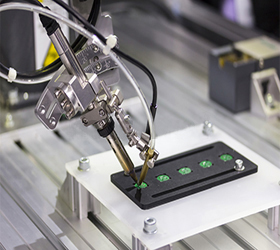
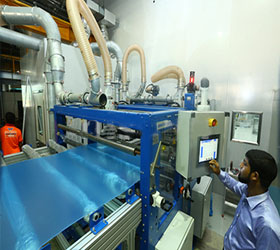
| Smart phone | Food | Electronic & Electrical Appliances | ||
 |  |  | ||
| Solar cell | Semiconductor | LCD | ||
 |  |  |