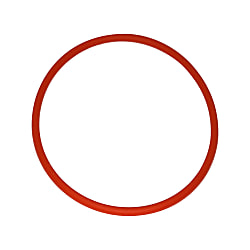
AS568 (ARP568) O-Ring (Packing and Gasket)
Caution
Product Description
[Features]
·It has good sealing performance with self-sealing action despite its simple structure
·Stable sealing performance even under high pressure
·Compact installation space and easy installation
·Sealing is not directional and is possible from both sides
[Applications]
·Can be used for various machines
·The material can be selected depending on the usage conditions, so it can be used in a wide range of applications, both for movement and for stationary use
Drawing

Product Specification

This synthetic rubber ring was made for the purpose of sealing liquid and gases in reciprocating motion or fixed areas
Specifications Table
| Material | JIS Standard | Old JIS standard | Color | Hardness Type A durometer | Operating temperature range |
| Nitrile Rubber | NBR-70-1 | Class 1 A | Black | A70 +/- 5 | -30℃ to +100℃ |
| NBR-90 | Class 1 B | A90 +/- 5 | -25℃ to +100℃ | ||
| NBR-70-2 | Class 2 | A70 +/- 5 | -25°C to +80°C | ||
| Silicone rubber | VMQ-70 | Class 4C | Vermilion | A70 +/- 5 | -50°C to +200°C |
| Fluoroelastomer | FKM-70 | Class 4D | Black | A70 +/- 5 | -15°C to +200°C |
| AS568 Nominal number | O-ring nominal size (in) | O-ring actual size (mm) | AN 6227 1516 | |||||
|---|---|---|---|---|---|---|---|---|
| W | d | D | d2 | d1 | ||||
| 001 | 1/32 | 1/32 | 3/32 | 1.02 | +/- 0.07 | 0.74 | +/- 0.10 | - |
| 002 | 3/64 | 3/64 | 9/64 | 1.27 | 1.07 | - | ||
| 003 | 1/16 | 1/16 | 3/16 | 1.52 | 1.42 | - | ||
| 004 | 1/16 | 5/64 | 13/64 | 1.78 | 1.78 | +/- 0.12 | - | |
| 005 | 1/16 | 3/32 | 7/32 | 2.57 | - | |||
| 006 | 1/16 | 1/8 | 1/4 | 2.90 | 1 | |||
| 007 | 1/16 | 5/32 | 9/32 | 3.68 | 2 | |||
| 008 | 1/16 | 3/16 | 5/16 | 4.47 | 3 | |||
| 009 | 1/16 | 7/32 | 11/32 | 5.28 | 4 | |||
| 010 | 1/16 | 1/4 | 3/8 | 6.07 | 5 | |||
| 011 | 1/16 | 5/16 | 7/16 | 7.65 | 6 | |||
| 012 | 1/16 | 3/8 | 1/2 | 9.25 | 7 | |||
| 013 | 1/16 | 7/16 | 9/16 | 10.82 | - | |||
| 014 | 1/16 | 1/2 | 5/8 | 12.42 | - | |||
| 015 | 1/16 | 9/16 | 11/16 | 14.00 | - | |||
| 016 | 1/16 | 5/8 | 3/4 | 15.60 | - | |||
| 017 | 1/16 | 11/16 | 13/16 | 17.17 | - | |||
| 018 | 1/16 | 3/4 | 7/8 | 18.77 | - | |||
| 019 | 1/16 | 13/16 | 15/16 | 20.35 | +/- 0.15 | - | ||
| 020 | 1/16 | 7/8 | 1 | 21.95 | - | |||
| 021 | 1/16 | 15/16 | 1 1/16 | 23.52 | - | |||
| 022 | 1/16 | 1 | 1 1/8 | 25.12 | - | |||
| 023 | 1/16 | 1 1/16 | 1 3/16 | 26.70 | - | |||
| 024 | 1/16 | 1 1/8 | 1 1/4 | 28.30 | - | |||
| 025 | 1/16 | 1 3/16 | 1 5/16 | 29.87 | - | |||
| 026 | 1/16 | 1 1/4 | 1 3/8 | 31.47 | - | |||
| 027 | 1/16 | 1 5/16 | 1 7/16 | 33.05 | - | |||
| 028 | 1/16 | 1 3/8 | 1 1/2 | 34.65 | - | |||
| 029 | 1/16 | 1 1/2 | 1 5/8 | 37.82 | +/- 0.25 | - | ||
| 030 | 1/16 | 1 5/8 | 1 3/4 | 41.00 | - | |||
| 031 | 1/16 | 1 3/4 | 1 7/8 | 44.17 | - | |||
| 032 | 1/16 | 1 7/8 | 2 | 47.35 | - | |||
| 033 | 1/16 | 2 | 2 1/8 | 50.52 | - | |||
| 034 | 1/16 | 2 1/8 | 2 1/4 | 53.70 | - | |||
| 035 | 1/16 | 2 1/4 | 2 3/8 | 56.87 | - | |||
| 036 | 1/16 | 2 3/8 | 2 1/2 | 60.05 | - | |||
| 037 | 1/16 | 2 1/2 | 2 5/8 | 63.22 | - | |||
| 038 | 1/16 | 2 5/8 | 2 3/4 | 66.40 | - | |||
| 039 | 1/16 | 2 3/4 | 2 7/8 | 69.57 | +/- 0.38 | - | ||
| 040 | 1/16 | 2 7/8 | 3 | 72.75 | - | |||
| 041 | 1/16 | 3 | 3 1/8 | 75.92 | - | |||
| 042 | 1/16 | 3 1/4 | 3 3/8 | 82.27 | - | |||
| 043 | 1/16 | 3 1/2 | 3 5/8 | 88.62 | - | |||
Product Feature Details
- Generally installed in a groove, it exerts its sealing function through the stress generated by moderate compression.
- This product is easier to install than any other packing, takes up less space, and can be done the same way by anyone, and its self-sealing action provides stable sealing performance even under high pressure using only an O-ring.
- It can be installed with a small amount of compression (squeeze) and has relatively low kinetic frictional resistance for higher efficiency.
- It does not cause overtightening of nuts when used for fixing.

Principle of action
Fig. 1: When an O-ring seals a fluid with no or low pressure, the seal is maintained by a squeeze equivalent to a percentage of the cross-sectional diameter of the O-ring.
Fig. 2: As the fluid pressure increases, as shown in the figure, the crushed O-ring in the groove is pushed from the pressure side, shifting to one side and sealing with a self-sealing effect.
Fig. 3: If the pressure increases further and exceeds 10 MPa, the softness of the rubber will cause the O-ring to be damaged by protruding into the clearance.
Fig. 4: To prevent this, if there is pressure on the opposite side of the pressure direction or on both sides, attach backup rings made of leather or fluoropolymer to both sides of the O-ring.
Cautions and Prohibitions
Cautions
- The dynamic O-ring smooths the sliding metal surface finish. (It should be about 1.5S.) The inside of the groove should be about 3S.
- If the reciprocating sliding surface has holes, etc., take care to protect them.
- Do not use more than 2 O-rings in the same location.
- Pay attention to the groove design.
- If the O-ring breaks down, it will suddenly leak and cause an accident, so be sure to replace it at the end of its useful life for dynamic applications.
- Due to its rubbery nature, it will age in the air, so care must be taken when storing it.